The honest answer to what a dryer vent cleaning costs is that it depends on your setup, and any figure given without seeing the vent first is a guess. What moves the estimate is the physical reality of the run: its length, its path, how hard it is to reach, and whether anything beyond a standard cleaning has to happen while a technician is already on site.
The length and path of your vent run
A short, straight run from the dryer to a nearby exterior wall takes less time and effort to clean thoroughly than a long run with several bends, or one that travels a long horizontal distance before it reaches the outside. Every turn is a spot where lint collects more heavily, so a run with multiple elbows takes more time to clear completely than a direct path.
Homes where the laundry room sits far from an exterior wall, common in basements across older New Jersey towns where the laundry area was added well after the house was built, tend to have the longest and most indirect runs. Newer construction with the laundry close to an exterior wall usually has a shorter path and fewer joints to work through.
How the vent is reached
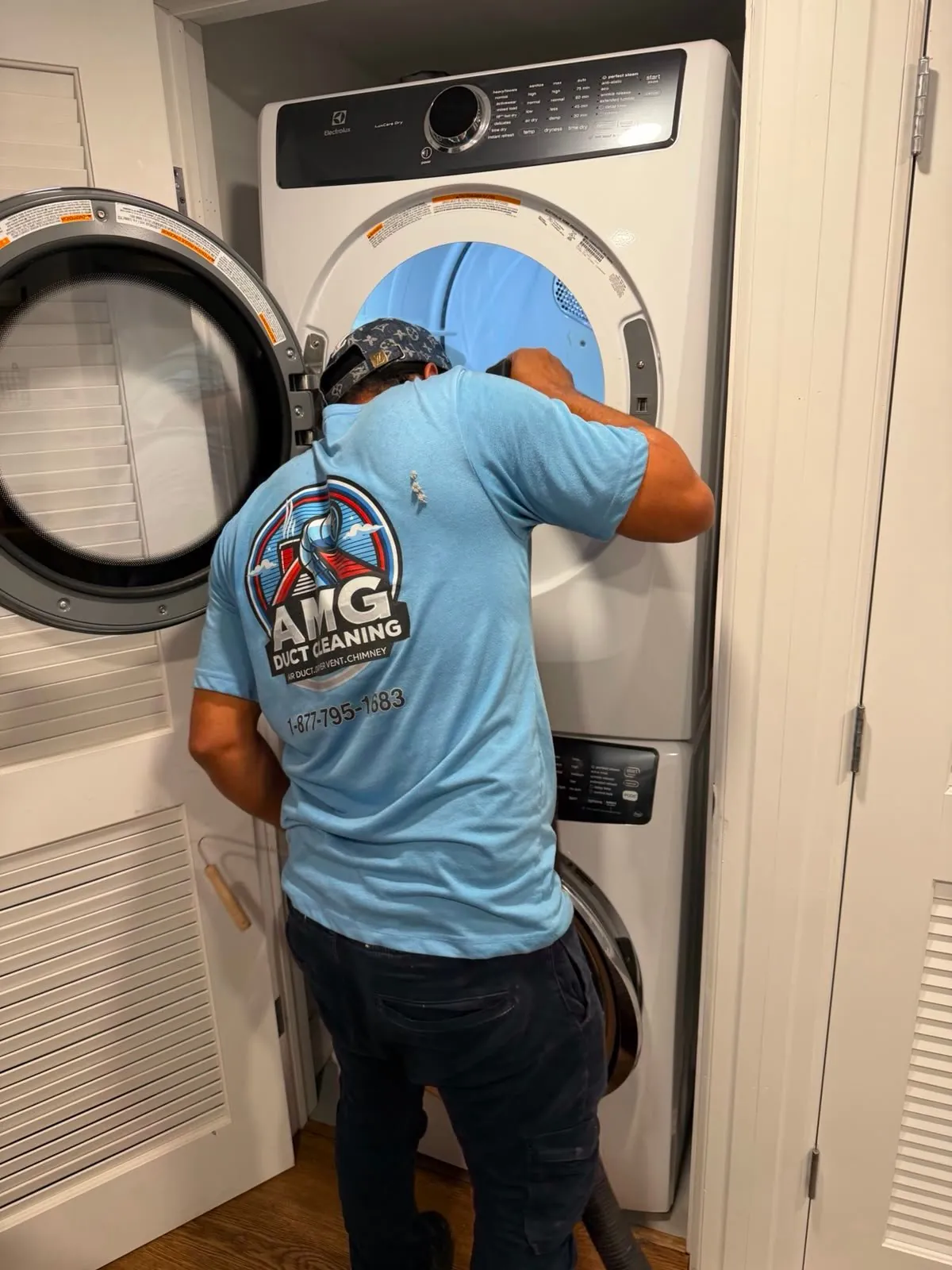
Where the vent exits the house changes what the job involves. A run that ends at a wall hood near ground level is straightforward to reach from both inside and outside. A run that exits through the roof, common in homes with upper-floor laundry rooms across Somerset County and Morris County, calls for roof access and different equipment to clean safely. A dryer wedged into a tight closet with little clearance behind it also takes longer to work around than an open laundry room with space on three sides.
The condition of the vent itself
A standard cleaning assumes the vent is intact and properly connected. If a technician finds a crushed section, a disconnected joint, or venting material that belongs in the scrap pile rather than in a wall, the scope of the visit changes and the conversation shifts toward dryer vent installation. Homes with older flexible foil or vinyl accordion style venting often take longer than homes with rigid metal duct, because that material holds lint in its ridges and tears when it is brushed hard.
The type of home you live in
A single-family home with a basement laundry room, a condo tied into a shared vent chase, and a townhome with an upper-floor laundry closet each present a different job before anyone looks at how much lint is sitting in the run. Multi-unit buildings sometimes require coordinating access with a property manager, or working out whether the shared portion of the system falls under the building's responsibility rather than an individual unit's. None of that changes what a cleaning involves, but it does change how the visit is scheduled and scoped.
Whether the vent calls for more than a cleaning
Sometimes a run that looked like a straightforward cleaning turns out to be more than that once a technician is inside it. A cracked termination cap, a joint that was never sealed, a damper flap held open by packed lint, or a run that switches between mismatched materials partway through are the kinds of findings that go past clearing lint. When that happens, the scope of the visit expands to match what the vent calls for, which is one more reason an inspection tells you more than a number quoted sight unseen.
Why a walkthrough beats a phone quote
Because so much of the scope belongs to your home's layout and the state of the material, a figure given over the phone without seeing any of it is not an estimate. A technician who walks the run can measure its length, find the access points, and judge the material before describing what the work involves. The walkthrough also keeps surprises out of the middle of the job, since anything past a standard cleaning gets explained before it starts rather than after.
If your dryer has been running two cycles to finish one load, or the laundry room feels warm and damp when the load ends, the run has earned a look regardless of where the estimate lands. AMG's dryer vent cleaning clears the full path from the dryer connection to the termination cap, checks the damper flap, and flags any section of material that is failing, so you know what you are working with before the next load goes in.