
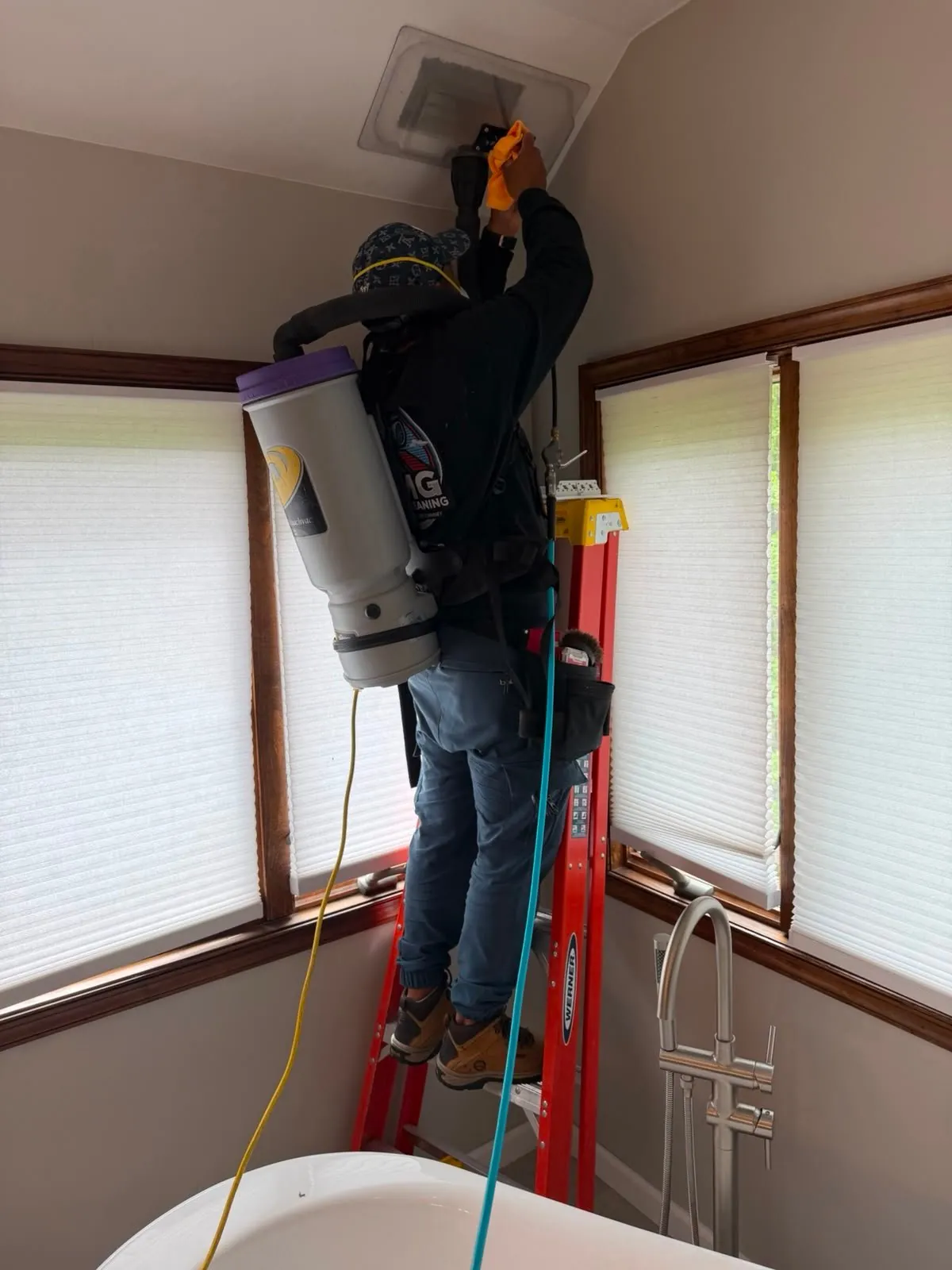
When a room barely gets any air from its vents, the natural assumption is that the furnace or air conditioner is losing strength. Often the equipment is fine and the trouble sits somewhere along the path the air travels to reach that room. Ductwork carries conditioned air through the whole house, and any weak point on that path, a leak, a crushed section, a joint that pulled apart, quietly eats into airflow long before anything changes at the equipment.
Common duct problems that choke airflow
Leaks at the joints are the most common culprit. Every gap where air escapes before reaching a room is air the system paid to heat or cool for nothing, and a house with several small leaks loses a meaningful share of its output before it ever arrives at a register. Crushed or kinked flex duct is the next most frequent, usually from insulation, stored boxes, or another duct pressing against a flexible run in an attic and pinching it half shut. A partly collapsed duct restricts air the way a kinked garden hose restricts water.
Disconnected sections are the severe version of the same fault, where a joint has come apart and air pours into an attic, a crawlspace, or a wall cavity instead of reaching a room at all. That turns up most in older systems, or in houses where runs were added and modified over the years with little attention to how each section was secured.
Signs the airflow problem is in the ductwork
A few patterns point at the duct rather than the equipment. If one or two rooms sit warmer or colder than the rest of the house however the thermostat is set, air is not reaching them the way it should. A system that runs constantly without catching up to the setting is another clue, since it may be compensating for air escaping on the way. Rattling, whistling, or a faint hiss near ductwork in an attic or basement points to air forcing itself through a gap that should not be there at all.
What a repair focused on airflow involves
The first step is locating where the loss happens, since airflow problems often come from more than one fault at once. From there the repair follows what was found: resealing leaking joints, straightening or replacing crushed sections, reconnecting anything that has come apart, and checking that the duct sizing and layout suit the rooms they serve. In older homes in cities like Newark, Paterson, and Trenton, where ductwork has been modified across decades of ownership, the layout itself has often gone inefficient in ways no single patch addresses, and the repair has to take in the whole path rather than the most obvious gap.
When duct sizing is part of the problem
Not every airflow issue traces back to damage. In some homes, particularly additions or rooms converted from unconditioned space, the duct feeding that area was undersized for what it now serves, or one supply run was asked to cover more square footage than it can carry. That shows up as a room that has never held a comfortable temperature, rather than one that changed suddenly, which is a useful clue when narrowing the cause. The fix there goes past resealing and reconnecting, because the layout itself has to change.
This is common enough in homes with additions or finished basements across New Jersey that it is worth raising with a technician when a room has never performed well, even after repairs have handled leaks or damage elsewhere in the system.
Airflow is the measurement that settles the argument. Before anyone opens a ceiling, hold a hand at the weakest register and then at the strongest one, and note where the difference shows up. Air duct repair works back from that comparison, since the point where the air is still strong tells a technician how far along the run the loss begins.