Westfield holds prewar Colonials, Dutch Colonials, Tudors, and split levels built across several eras, and each of those house types carries its own duct configuration. Many went up before central air conditioning was standard, so the ductwork was retrofitted years after the framing, and in plenty of houses nobody has opened it since. This guide covers what a Westfield homeowner can use: when a cleaning becomes a priority, the signs worth watching, what a full visit involves, what changes the scope of a job, and the red flags that show up while comparing companies.
When Westfield homes are due for a duct cleaning
Age and installation method matter more than any fixed schedule. In older Westfield homes, especially where a forced air system arrived after original construction, the ductwork runs through basements, crawl spaces, and chases that were never designed to hold it. Joints in a retrofitted system tend to have more gaps than duct built into new construction, and those gaps let dust, insulation fibers, and debris out of unconditioned spaces and into the airstream every time the furnace or air conditioner runs.
A house that has been through a renovation, even a single bathroom, is worth inspecting afterward. Construction dust travels into the return air and settles through the whole system, not only the room where the work happened. Westfield's mature streets add a layer of their own, since houses under large trees pull more organic debris and pollen toward intakes and duct gaps than houses on open lots. None of this puts every home on the same interval. Age, renovation history, and the lot itself decide when a look is worth scheduling.
Warning signs your ductwork wants attention
A few signals show up before most homeowners connect them to the ductwork. Dust that resettles near a register within days of a wipe down is usually being fed by the duct rather than the room. A musty smell that arrives when the furnace or air conditioner first kicks on and fades after a few minutes points to moisture or debris sitting inside the system, and basement runs are prone to it when summer humidity puts condensation on the metal. Someone in the house sneezing or feeling congested indoors, particularly in the first minutes after the system starts, is worth a closer look as well.
Visible debris blowing out of a register, or droppings and nesting material near a vent opening, is a signal rather than something to wipe away and forget. Uneven airflow, where one room never reaches the thermostat setting while the rest of the house is fine, can point to a restricted or leaking branch. And if nobody can recall the last inspection, or you bought a Westfield house with no service history at all, that by itself is a fair reason to schedule one.
What a full cleaning involves
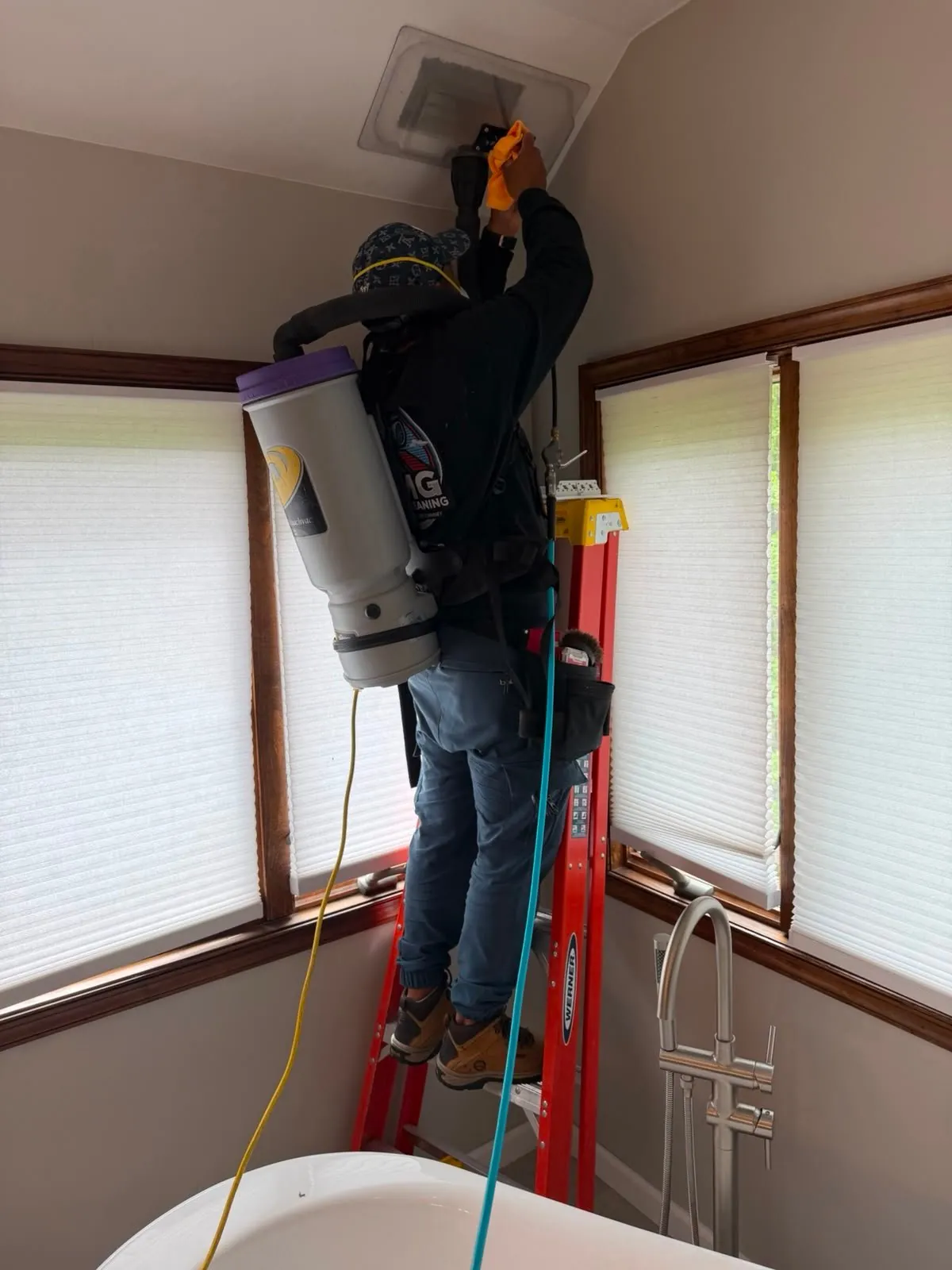
A proper air duct cleaning opens with an inspection, not a vacuum hose held against the nearest vent. The technician checks the type and condition of the ductwork, looks for visible damage or a disconnected branch, and flags anything that has to be handled before cleaning starts. From there the registers get sealed and a vacuum collection unit is tied into the system, putting the whole network under negative pressure. Air moves inward toward the collection point instead of outward into the room, so debris knocked loose during the work travels to the vacuum rather than onto your floors and furniture.
Dust that has packed against duct walls for years does not fall off on its own. Rotary brushes and compressed air whips break it loose, with the technique matched to the material, since rigid metal takes harder brushing than older fiberboard. Every supply and return register comes off and gets cleaned on its own, because debris collects behind the grille where a cloth never reaches. A complete visit also covers the air handler, the blower compartment, and the coil area, since anything sitting there is downstream of the filter. Drop cloths go down before the work starts and access points stay covered between passes, so the house should not look dustier when the crew leaves than it did when they arrived.
What changes the scope of a cleaning
Every duct system is different, which is why an honest assessment comes from someone standing in your basement rather than from a figure picked over the phone. The size of the house and the count of supply and return vents is the most visible factor, since more vents mean more duct to clear and more registers to pull and service. Material matters too. Rigid sheet metal, flexible duct, and older fiberboard each respond differently, and some take longer to work through without damaging them.
Access carries real weight. Duct running above a finished basement ceiling, through a low crawl space, or across an attic with little clearance takes longer to reach than an open basement where everything is exposed. Condition adds work of its own. A system with visible mold, pest activity, or heavy contamination takes more than a system that is only overdue, and if the technician finds a crushed section or a missing access panel, that repair sits outside the cleaning itself. AMG gives a free estimate for every Westfield home, so the scope is settled before anyone starts.
Red flags to watch for when hiring
A figure quoted over the phone with no look at your house is the first thing to treat carefully, because nobody can assess ductwork sight unseen. Be wary of a low headline number attached to a per vent structure that leaves out the trunk lines, the return system, and the air handler, since what you are asked to pay once the technician is in the basement can bear little resemblance to where you started. Pressure to decide on added work on the spot, with no time to think, is another signal worth taking seriously.
A company confident in its work will walk the house, explain what it found, and write a scope before anything begins. It will separate what belongs to a standard cleaning from what counts as repair, and it will answer direct questions about method without pushing for a decision that afternoon. Ask what happens if the technician finds something unexpected once the work is underway, such as a damaged section of duct or evidence of pests. A clear answer given before the visit, rather than discovered halfway through it, tells you most of what you want to know about how the job will go.
What a Westfield visit looks like
AMG serves Westfield and the rest of Union County, and the crew that cleans the ducts can also handle the dryer vent cleaning on the same visit while the equipment is already set up. Before you book anything, walk your own house once: pull a return grille, look at the first foot of duct with a flashlight, and note which room never holds its temperature. Those two observations will shape the conversation more than any brochure can.